Everything is wrong with the world. Tell me a year ago that the two most entertaining races of the next 12 months would be Las Vegas and Miami and I’d have called you insane. And yet here we are.
Lando Norris has his first win, becoming the first British driver to do so for McLaren since Jenson Button in Brazil 2012, almost 12 years ago. I personally couldn’t be happier with the result, and, honestly, it looked like Max Verstappen couldn’t have been either – he looked more animated than he has been for a while!
However, there are some on the internet talking about how the only reasons that Norris won are that a) the safety car came out, and b) the safety car procedure happened wrong, so this is what I’ll be talking about today. The former of these issues I think is a fair assessment, though somewhat misguided in its application, and the latter is objectively incorrect.
The Opening of the Race
Let’s do a quick run-through of the opening beats of the race before I get into the meat, to refamiliarise everyone with the events that unfolded.
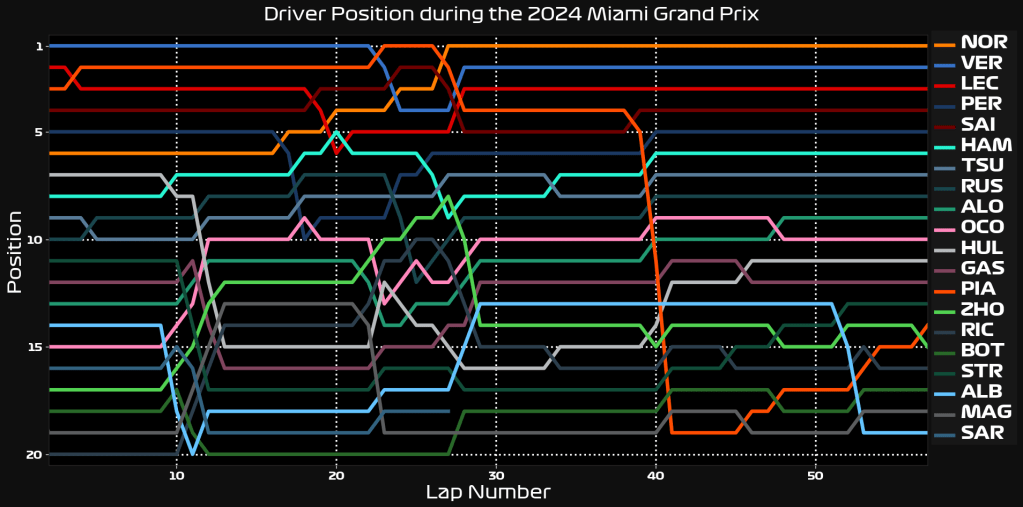
Verstappen started on pole and remained there, despite his teammate seemingly trying very hard to take him out at Turn 1 on the first lap. This lasted until he pitted for new tyres on Lap 23 during the Virtual Safety Car that came out after Max himself hit a bollard, resulting on the bollard-cum-debris being dangerously on the racing line on the long final straight. Piastri, who started sixth, made it up to second place, with Charles Leclerc and Carlos Sainz holding position behind him. An early pit stop for Perez put him down the order after having to deal with traffic, with Leclerc boxing later on 19. Piastri and Sainz both boxed on Lap 27, dropping them from P1 and P2 to P4 and P5 respectively, while McLaren decided Norris should go long on his first stint after starting 5th and so didn’t stop. They were hoping for a safety car, which given that a) we’ve had one in 50% of the previous (admittedly two) Miami GPs, and b) it actually happened, seemed like a good strategy. If you bet on a Williams crashing in a grand prix weekend in 2024, you can seemingly make some easy money.
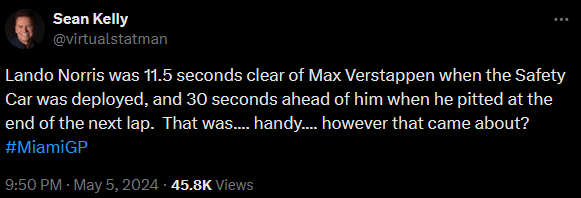
This meant that when Sargeant and Magnussen did tangle on Lap 28, resulting in Berndt Maylander’s safety car coming out, the top running order was Norris, Verstappen 11.5 seconds behind, then Leclerc, Piastri, Sainz, and Perez.
Could Norris have come out ahead?
The safety car coming out ended up interfering with the gap between Norris and Verstappen. It came out between them both, so Verstappen was forced to slow his pace to keep behind the only Mercedes that will be in front of him this season, while Norris was able to continue at the standard VSC delta. This increased the gap over the first safety car lap to over 30 seconds, meaning Norris was able to do a full pit stop while retaining first place. Thanks to the pace of the McLaren as well as floor damage Max accrued clattering over the curbs and taking out a bollard on turns 14/15, Norris was able to cruise to victory, gapping Max’s Red Bull by a few tenths per lap.
My first question is whether, without the safety car coming out between them, Norris could have still come out ahead of Verstappen. Pit stops lose quite a lot of time during normal racing conditions, but this is minimised during a safety car thanks to the cars still on track going a lot slower than normal. So, the question is how much time does a pit stop under a safety car gain compared to one under normal racing conditions?
According to formula1.com, a pit stop under normal conditions loses 19.6 seconds, assuming that there’s been a 2.5 second pit stop. Given McLaren’s 2.1 second pit stop, Norris would have lost 19.2 seconds under normal circumstances, putting him behind Sainz, and ahead of Perez. This is assuming Norris would have pitted on the same lap even if there were no safety car, but this wouldn’t have been the case as McLaren was purposefully extending his stint in the hopes of a safety car.
To work out how much time a pit stop under safety car gains you, you need to look at how much a car on track will slow down between the entrance of the pits and their exit. To do that, I’ve assumed that the delta for a car under safety car conditions, but not yet picked up by the safety car itself, is the same as that as under a VSC. Luckily, thanks to Max’s hatred of bollards, we had a VSC to use as a comparison. I’ve looked a the telemetry for two drivers, Zhou and Ricciardo, and have estimated the time loss from normal racing conditions to being under a VSC to be between five and six seconds.
If you check Zhou’s telemetry below, Lap 24 is a non-VSC lap, while laps 22 and 23 are the beginning and ending VSC laps, respectively. The delta section measures the difference to Lap 24, i.e. to the non-VSC lap, so we can see the effect of a VSC on lap time. On lap 22, when the VSC was called, Zhou loses roughly two seconds between Turn 18 (roughly at the level of the pit entrance) and the end of the lap. On lap 23, when the VSC ends, he loses three to four seconds between the start of the lap and Turn 2, where the pit exit is. So in total, between 5 and 6 seconds.
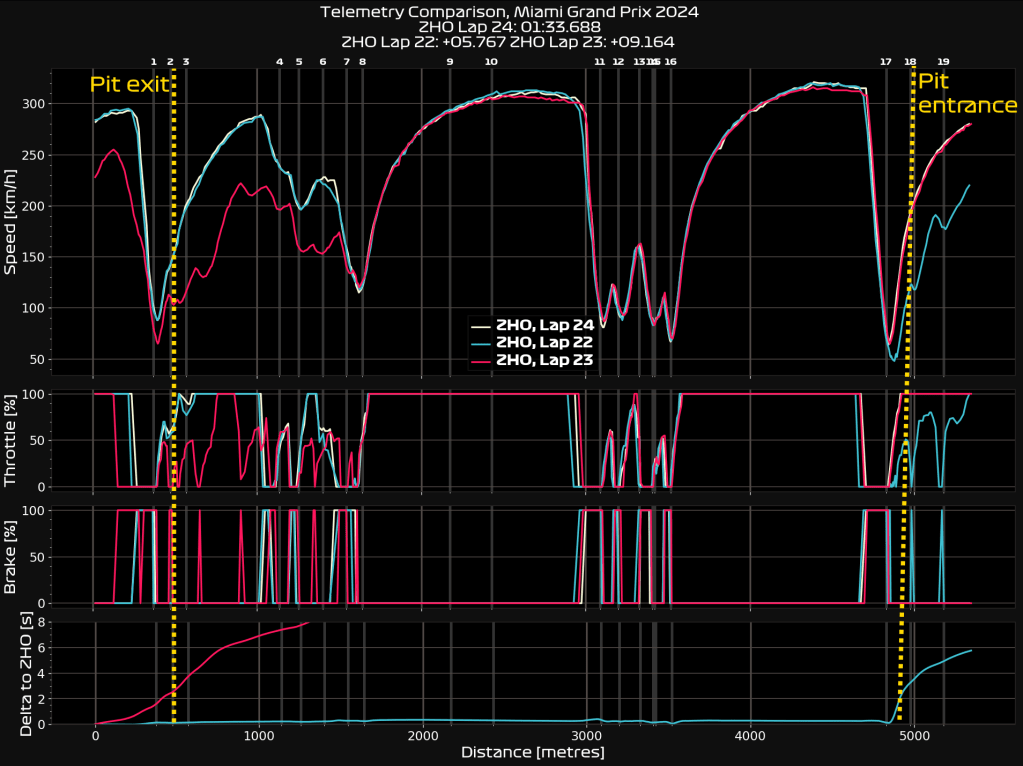
Therefore, had the safety car not picked up Verstappen and they’d been under the same conditions, Norris would have lost maybe 14 seconds and come out behind Verstappen, but probably ahead of Leclerc who was 14.2 seconds behind him pre-safety car.
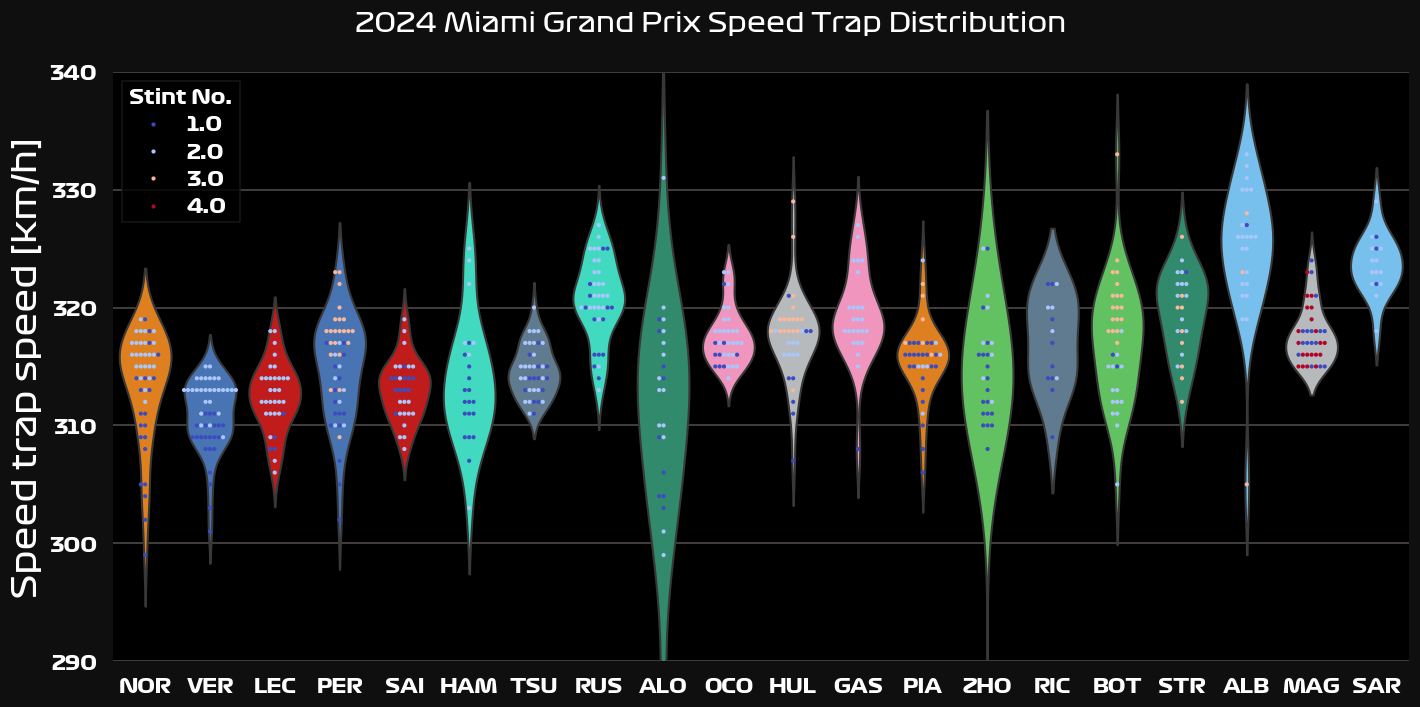
Whether Norris could have overtaken Verstappen is another matter which we’ll never know the conclusive answer to. Given Norris’ average (non-DRS aided) top speed of 313.5km/h and that he’d have had DRS on Verstappen, whose average top speed was only 310.9km/h, the answer is probably yes. However, maybe Norris would have destroyed his tyres in trying to overtake, and so he’d have been doomed to be re-overtaken or even not to have overtaken in the first place. We’ve seen plenty of times in Formula One where, even though a car following is quicker, dirty air coming off the leader ultimately ruins the chances of the chaser. Alternatively, maybe Leclerc would have had a go at Norris, as he did briefly on Verstappen upon the safety car restart, causing Lando to fall to third. It’s difficult to tell.
Was there an issue with the Safety Car?
The answer is no, there was not an issue with the safety car proceedings. Had I been a bit quicker with writing this article and it had come out three days ago, I could have looked clever rather than like I was bandwagoning on what sites like RacingNews365 have already reported. I promise I knew before they wrote what they did.
Basically, it was pure fluke that the safety car came out when it did. As per the FIA’s Formula One Sporting Code, section 55.6 reports that
The safety car will join the track with its orange lights illuminated and will do so regardless of where the leader is.
FIA Formula One Sporting Code, Section 55.6
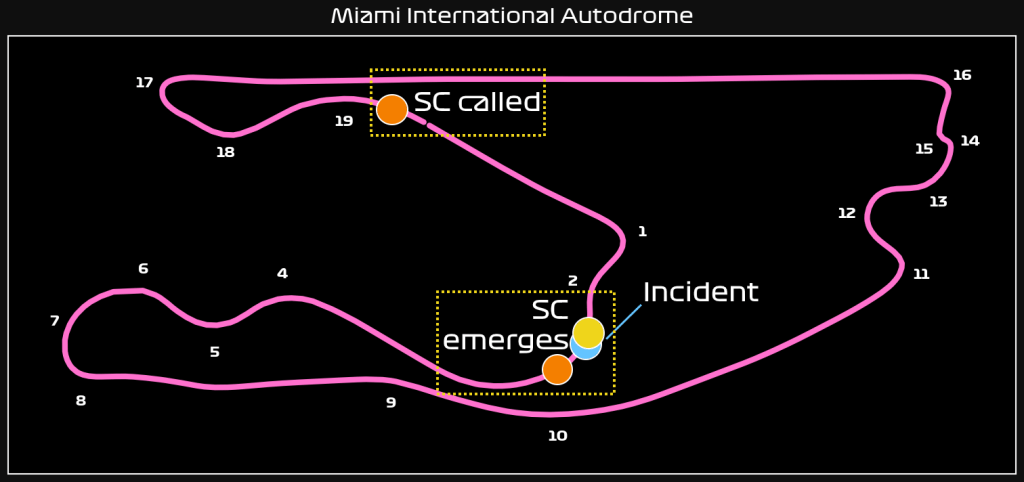
That is to say, the safety car should not aim to come out just in front of the leader of the race and just behind lapped car in front of the leader. Rather, it comes out instantly, catching whatever the cars happen to be behind it. In this case, Norris was just in front of it when it came out, while Verstappen was just behind it. In my ‘expert analysis’ of the Sky Sports Extended Highlights; without any cuts in the broadcast footage, the safety car came 17 seconds after the incident between Magnussen and Sergeant first happened, while Norris was on the pit straight. If you check my map below, you can see exactly where Norris was when the safety car was first called and where he was when it emerged on track.
Had Berndt Maylander aimed specifically for Norris, and so waited a lap before coming out, the entire pack would have gone past the site of the incident and Sargeant’s stricken car without being behind a safety car, somewhat nullifying the point of a it and probably requiring the recovery process to happen a lap later, extending the safety car period further.
Maybe the safety car could have been called a little sooner, but given the time period it normally takes (in one of the races this season it took more than a lap), I don’t think 17 seconds is something to complain over.
These circumstances, roughly, have happened in a race only two seasons ago, too. In Monza 2022, Ricciardo had an engine failure in the dying laps of the race, leading to the Safety Car coming out. It picked up Russell’s car first, who was running in P3, while leading Verstappen and Leclerc to run ahead and get free pit stops. It’s just that this time, everyone noticed and it potentially interfered with which driver won.
Of course, whoever the safety car comes out in between, its very existence interferes with who won, given that it bunches the pack up completely.
Conclusions
Overall, I think Norris obviously had luck involved in his win, but that car certainly had the pace of the Red Bulls this weekend and both McLaren drivers raced extremely well. Whether, without a safety car or the luck of where Lando was on the track when it came out, McLaren could have won at the weekend is unknowable. The main commentary team on Sky Sports being clueless as to why the Safety Car picked up Verstappen instead of Norris certainly didn’t help to stop the anger of some towards the FIA, so if you’re reading this Crofty, please re-read the Sporting Code on your way to Imola in just over a week! You said you did on the way to Miami, but apparently not closely enough…
Let’s hope for some more brilliant racing in the European stage of the season. I can finally say that Formula One is back for the first time since mid-2022! While Sainz has secured three victories since and Russell one, this is the first Grand Prix since Austria in 2022 where Max Verstappen was in contention for the win, but didn’t. A full 665 days before Miami. Long may it continue.
 Data Drive with Max
Leave a comment