Well I seem to have cursed him. In only the last post I was harking back to Alonso shenanigans at Monaco two years ago, and now we’re seeing even more in Australia. Sauber, meanwhile, has quietly, if vibrantly, been having an awful season, typified by their luck in the pit boxes. I’ll get to both of those in a second.
The Australian Grand Prix itself was an interesting one. On the one hand, we had a winner who wasn’t Max Verstappen! On the other, if you told me the winning car was a Red Bull painted scarlet, and Carlos smuggled in Max to take his place, á la James May and the Stig, I would believe you.
A classic Max Verstappen victory in 2023/24 is him “only” qualifying P2 — giving everyone hope — only for him to pass the lead car on the first lap DRS is enabled, and then to cruise to victory. In Australia, Carlos qualified P2, passed the lead car on the first lap DRS was enabled, and then cruised to victory over the rest of the race. There was a lot of “anything could happen now” from the commentators, but it would have been nice for anything to happen. There were a mere 24 overtakes, with 9 of them being on Gasly after he tried an undercut which worked, but didn’t solve his Alpine’s pace issue.
Had Verstappen not DNF’d, I think we could have had an interesting race. Having said that, if he was able to mostly keep up with Sainz with his right rear brake became stuck on,[1] I think we should be worried for the rest of the season. Perez was also stuck in his usual doldrums of the lower-middle points, though without Hamilton’s engine breaking on Lap 17 we may have seen a battle between them. Overall, it wasn’t the best Australian Grand Prix we’ve ever had. The one upside was my mother’s — potentially performative — surprise when I told her a driver other than Verstappen won.
Now, given the early-morning Grand Prix and the expected outcome with a Max Verstappen pole, I didn’t actually get up for it. Because of this, in my pre-coffee haze I foolishly went onto Reddit and saw a few spoilers. One of those was the double Mercedes DNF.
On lap 50 I was beginning to think I had hallucinated. While we had the Hamilton DNF in the beginning third of the race, Russell was still going strong behind Alonso in a battle for 6th place. With only two laps to go of the Grand Prix I didn’t expect anything to happen, least of all what actually did.
However, on lap 57 out of 58, Alonso braked 100 metres early into Turn 6. While Russell never collided with Alonso, the dirty air that the Aston Martin left in its wake caused him to lose the rear end, skid over the gravel, hit the barrier, and rebound onto the track. I’ve created a graph showing the Alonso’s telemetry from this lap as well as the lap before from just before Turn 3 to just after Turn 8.
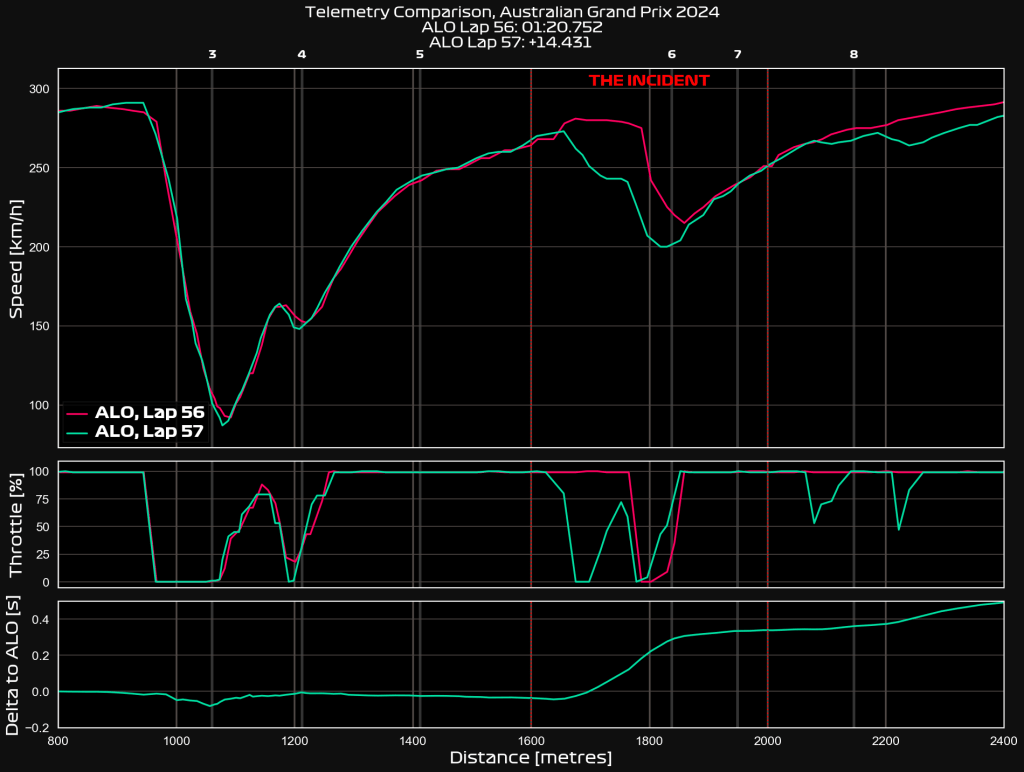
The lap of the Incident (57) is green, while the lap before is red. The corner numbers are at the top.
This incident has caused a lot of discourse over the internet, with Alonso fans (it was Russell’s fault, he lost control, also pro-British biased FIA) and Mercedes fans (Fernando brake checked Russell) battling it out and shouting at each other. Jolyon Palmer in his analysis on F1TV I think brought the greatest amount to the conversation, so a lot of my opinions can probably be attributed to him.
Simply put, I think Alonso was in the wrong, but he wasn’t wrong to the tune of a 20 seconds penalty. He braked 100 metres early, slowing down a lot sooner than Russell expected him to, but at the smallest gap there was still a full car between them. He was 20km/h slower at the apex than he was the lap before (look at the top chart), but last race Magnussen, when doing his blocking, slowed 30km/h from his previous non-blocking lap. I say that, but there is a difference to be acknowledged. Magnussen slowed by lifting off, i.e. where he had been full throttle the lap before, he was at 0%, while Fernando actually braked.
However, as Jolyon pointed out, Fernando had done something pretty similar to this only three races ago in Abu Dhabi last year to no penalty. If you check the telemetry below from that race, you can see he started slowing 300 metres earlier than the previous lap, trying to get Hamilton (who he was racing at the time) to cross the DRS detection point first and so get himself access to the extra speed for the long main straight. He failed with Hamilton getting DRS, and you can see the result in Lewis’ considerably higher speed for that entire kilometre. The FIA did nothing here, probably because there was no crash, despite Hamilton complaining on the radio.
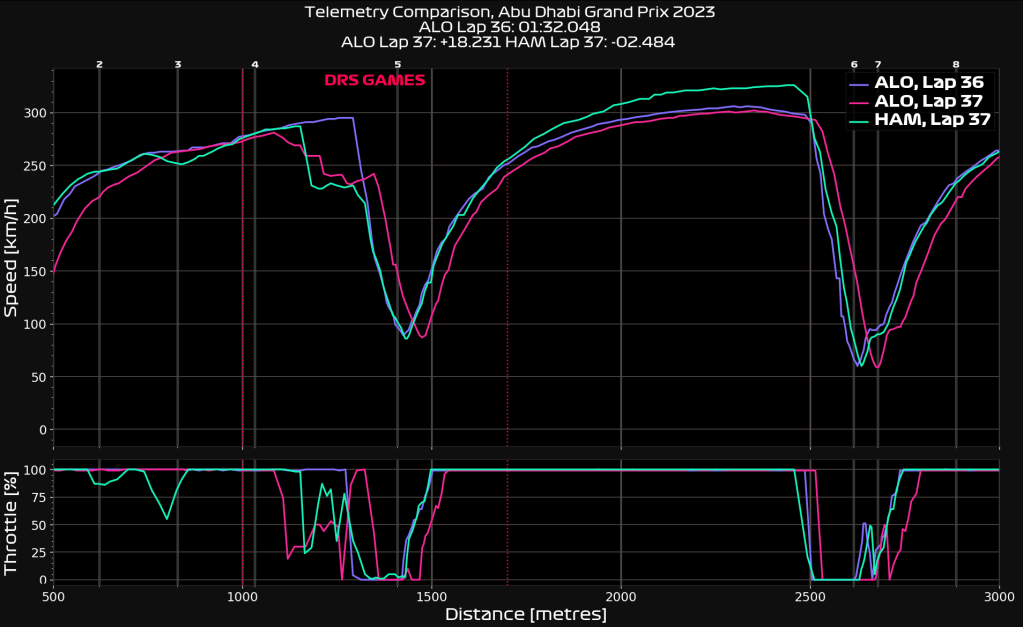
Abu Dhabi lap 37 DRS Games. Alonso lap 36 for comparison is purple. Alonso lap 37 is pink, Hamilton lap 37 is teal. Since Alonso’s lap 37 him coming out of the pits, the data is pushed rightwards by ~100 metres.
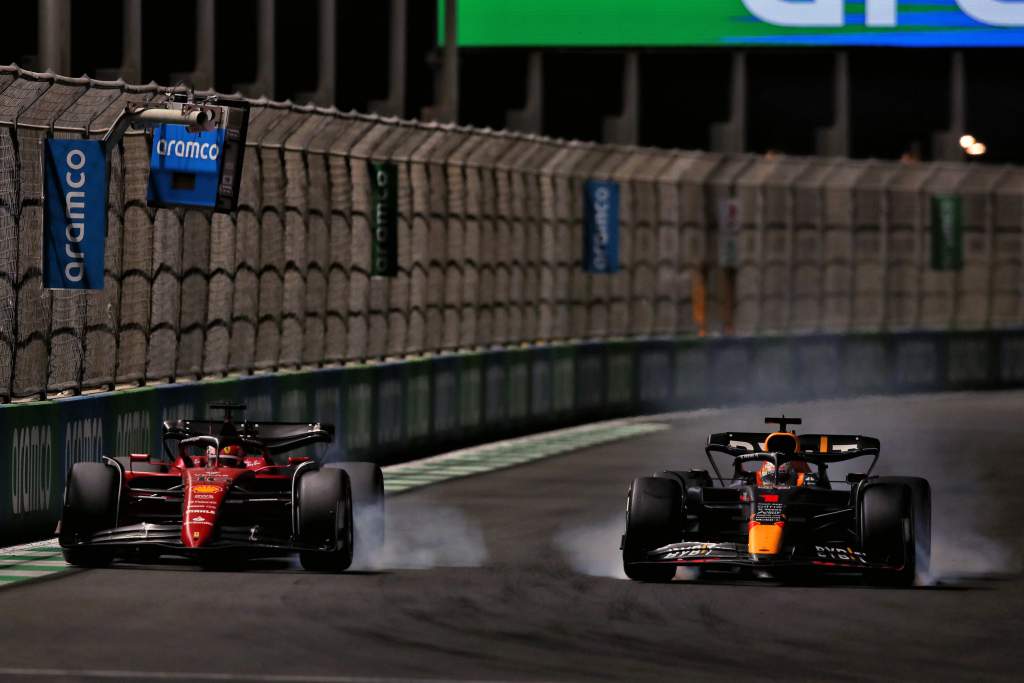
There’s another example you can give from two years ago in Jeddah, where Max and Charles Leclerc were continually braking early whilst playing DRS games as in Abu Dhabi. Both of them locking up simultaneously and going deep into the corner is an image burned into my mind. Again, no incident so no investigation.
Without trying to sound conspiratorial, another possible other factor is that his 20 second penalty dropped him from 6th to 8th, while a 10 second penalty would not have dropped him at all. Potentially this was something the FIA considered when looking at potential penalties.
Overall, I think it’s pretty clear that the main reason for Alonso’s severe penalty was how dramatic George’s crash and subsequent rebound into the track was. I think without it, Alonso may have been given a small penalty, if one at all.
Let’s move onto something less controversial. Sauber.
Thankfully, given their horrible livery — I said less controversial, not uncontroversial — and poor performance, they haven’t been getting much TV time recently. However, in Australia they stood out two times: when they were in their pit stops. This wasn’t a good thing.
Like most teams, they did a two-stop strategy. Bottas started on mediums, Zhou on softs, and both stopped twice for new hards. Two of these pit stops were slow — a 3.4 for Zhou and a 3.6 for Bottas[2]. These aren’t awful times, but they’re hardly respectable and were two out of the bottom four pit stops of a “normal” length where nothing massive goes wrong. While those pit stops were simply bad, they had two others which were truly abysmal. For Guanyu that was a glacial 20.2 second stop on lap 35, and for Valterri, a Sisyphean 31.2 seconds. This last one was caused by the wheel-nut coming loose from the wheel gun and and rolling out into the fast lane. For this, Sauber was fined €5000[3] which seems quite low given it could have torn the tyre off of an oncoming car, or worse. Maybe the FIA felt sorry for the Swiss team.
These aren’t isolated incidents either. Their pit stops in Saudi Arabia were all slow, with one at 28.7 seconds. In Bahrain, Bottas was subjected to a 52.4 second one!
I decided to check which teams are suffering most from pit stops and assembled the following bar chart. Each line across the bars mark an individual pit stop. This chart makes it unbelievably clear how colossally bad Sauber is at changing their tyres – while Red Bull cars have spent 20 seconds this season stopped, Sauber cars are approaching three minutes.
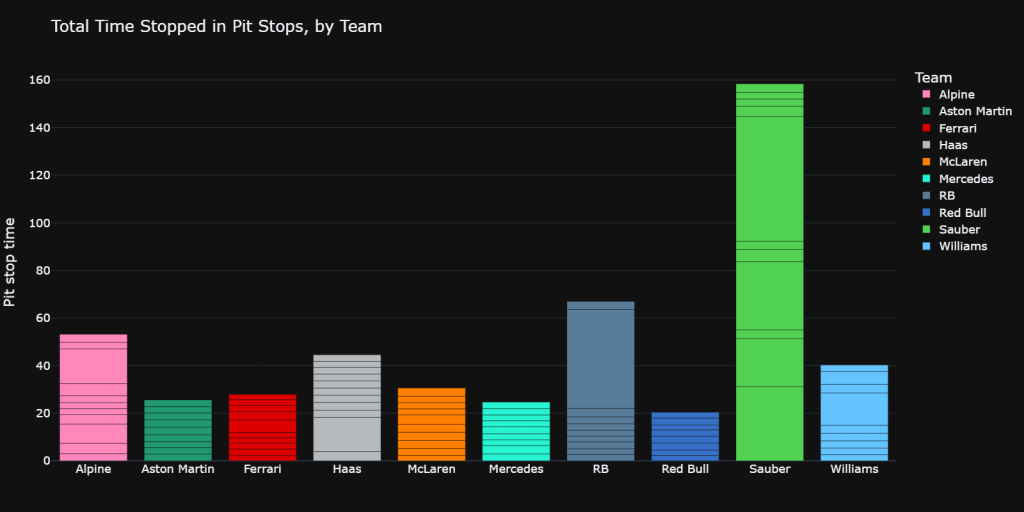
It’s worth noting that the number of pit stops that have been taken are not accounted for – though the minimum number is 8 (Red Bull) and the maximum is 11 (Haas/Sauber/Alpine), so there is no great difference in average time. If you want to see a graph of the average pit stop time, check here.
What’s going on here then?
Apparently, it’s the new lightweight material used for the wheel-nuts that Sauber has developed over the winter in order to — get this — speed up pit stop times. They’re causing cross-threading during the race, making tyres hard to remove[4]. The heat and wear caused by racing conditions have caused this problem to arise in a way that it didn’t during testing, so Sauber just didn’t stop the issue beforehand. Apparently, they won’t have a fix for three or four races, so expect that green column to continue rising.
The final important thing to note here is that this is not the fault of the mechanics. They have no control over whether a nut destroys the thread, and they do their best to fix it. I don’t envy them right now.
That’s all I have for today, I hope it was interesting. Not a good week for the green teams, all things considered…
 Data Drive with Max
Leave a comment