I think most can agree that the Bahrain Grand Prix that opened 2024 was not the same spectacle that we’ve expected of the opening Grand Prix of the past. It had 36 overtakes, which, while only one less than the same event a year before, is well below the average of 52 overtakes at a Bahraini GP. While a high number of overtakes does not a good Grand Prix make, it exemplifies an event that was lacking in excitement.
Saudi Arabia was looking to be similar, but the tedium was saved largely by the actions of one driver: Kevin Magnussen. Early on in the race on lap 11, Albon and Magnussen collided. Kevin squeezed the former into a wall, obviously oblivious of the Williams and rightly was given a 10 second penalty, effectively ruining his race goals for the lower clutches of the points. Another penalty after a clumsy off-track overtake on Tsunoda on lap 15 solidified this.
Hulkenberg, however, still had a chance. Thus began Kevin’s attempt to ruin the races of the RB, Williams, and Sauber drivers behind him in the name of a driver that Magnussen has historically had grievances with. Well, he succeeded! So well, in fact, that Hulkenberg had an entire pit stop’s distance to them for his final box lap.
This, then, is the data I’m to look at. I’m comparing the data for Magnussen to that of Hulkenberg — they’re in the same car, one maintaining a standard race pace whilst the other is delaying, making for a good comparison. My first visualisation is a scatter plot for the lap times of each driver over the race. The second, more interestingly, is the telemetry for both drivers on a specific delaying lap, and where specifically on the lap Magnussen was doing his delaying.
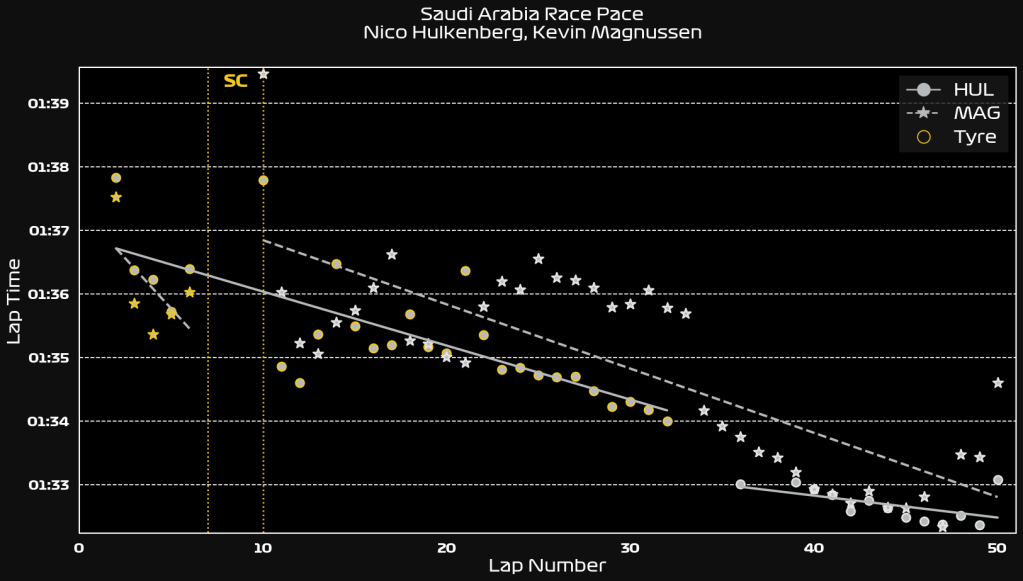
Here, Hulkenberg’s laps are the circular points, his line of best fit being solid, while Magnussen is the stars, with a dashed line of best fit.
After the safety car period ending on Lap 10, both Haas drivers are doing roughly the same lap times, between a 1:35 and a 1:36, with a few outlier laps. By lap 21, they’re split by Zhou and have a gap to each other of 5.2 seconds. This, however, is when Magnussen starts his train.
Looking at the chart, Magnussen’s laps jump from a 1:34.9 on lap 20, to 1:35.8 on lap 21, and finally to 1:36.2 on lap 22. He stays hovering around that level for the next 12 laps until lap 34, in the process ruining the races of a full third of the grid — Ocon, Albon, Tsunoda, Sargeant, Ricciardo, and Bottas — “losing” 15.4 seconds to his teammate from laps 22 to 33 and granting Nico a free pit stop. After that, he can’t have many friends among the Alpine, Williams, and RB teams!
Now, let’s have a look at where Magnussen was doing his delaying. To do this, I’m comparing the telemetry for Magnussen and Hulkenberg on lap 25. This is the lap where Kevin was at his slowest, doing a 1:36.56, with Nico at 1:34.73 — a difference of 1.83 seconds. This may not seem a lot, but for F1 it’s practically glacial and over 10 laps costs a lot.
This is actually three charts in one, all with a shared x axis for how far through the lap they are (in metres terms). The first graph is their speed at each point over the lap – a higher speed obviously being faster. The second is the percentage throttle they’re using, from 0% no throttle to 100% full throttle. The final one is Magnussen’s delta time to Hulkenberg — e.g. a 1 second delta means that, assuming they had started their laps at the exact same time, Magnussen arrived at that specific point on the track 1 second after Hulkenberg did.
Hulkenberg is green, Magnussen is purple. The corner numbers are labelled at the top.

The first thing to notice is the delta — the white line at the bottom. It rapidly increases in the first sector, and then remains mostly constant for the rest of the lap. This, then, is where Kevin is holding everyone behind him up.
Next, if you look at the first graph — their speeds over the course of the lap — you can see that Magnussen (red) is dramatically slower the entire way from turn 3 through to turn 10. Massively so from 5 to 9. This corresponds to the loss in delta.
Finally, let’s look at the throttle graph. This is a bit harder to see, but Hulkenberg (green) from turn 4 to turn 9 lifts at most 60% off in order to keep his speed up through the corner. Magnussen, however, lifts off fully several times, making no attempt to take the corner quickly.
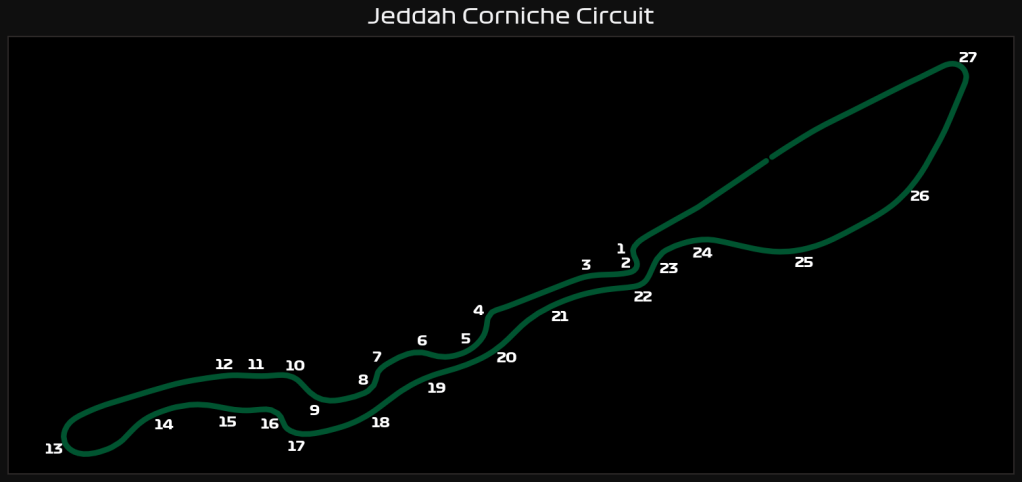
If you check the track map below, you can see just how winding this section of track is. It’s pretty much impossible to overtake and so Magnussen had free rein to slow his competitors right down and there was basically nothing they could do. Once they got to where you can actually overtake, Magnussen increased to normal racing speeds so they still couldn’t get past. I can only imagine the frustration for drivers behind him, as well as their engineers on the pit wall.
Overall, Kevin Magnussen and Haas as a whole played this race perfectly. It was very reminiscent of Perez’s blocking of Hamilton in Abu Dhabi 2021, where the former blocked the latter to the tune of about 10 seconds in only a few laps, allowing Verstappen to catch up to the back of the two drivers. To take an example from a less controversial race, you could use the Alonso Train from Monaco 2022, with Fernando separating the back half of the grid from the front by half a lap with ease. He was even joking about it on the radio!
It spiced up an otherwise boring race (it really says something when the first quarter of the race takes up 60% of Sky’s Extended Highlights on YouTube), and it’s rare enough that it doesn’t consistently change races. These blocking manoeuvres really highlight drivers’ skill and give them an interesting dynamic. Now, if one of my favourite drivers were the victim of one, I would absolutely be raging, but in this case none of them are so I can just live for the chaos!
But for now it’s on to Australia, where hopefully we can see a tad more racing.
 Data Drive with Max
Leave a comment